
Archiwum
-
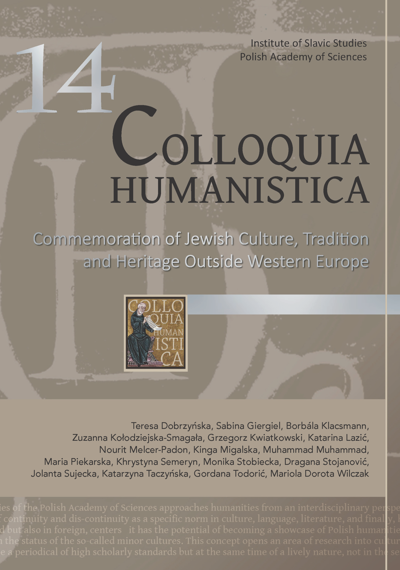
Upamiętnianie żydowskiej kultury, tradycji i dziedzictwa poza Europą Zachodnią
Nr 14 (2025) -

Kulturoznawcze studia cyfrowe w Europie Środkowej
Nr 13 (2024)Trzynasty numer "Colloquia Humanistica" zawiera przygotowany przez Roberta Kulmińskiego i Ondřeja Daniela blok tematyczny zatytułowany Mapowanie i propagowanie kulturoznawczych studiów cyfrowych w Europie Środkowej w Grupie Wyszehradzkiej (kierowany przez NGO Centrum Studiów nad Kulturą Popularną). Blok tematyczny otwiera artykuł czwórki autorów: Silvie Cinkovej, Barbory Hladki, Jiříego Mírovskiego i Sylvie Archaimbault (Historia danych w korespondencji André Mazona), w którym został zaprezentowany proces pracy nad wielojęzycznym zbiorem korespondencji francuskiego slawisty André Mazona. Autorzy opisują cztery fazy cyklu życia danych – gromadzenie, analizę, anotację, licencjonowanie i udostępnianie. Robert Kulmiński (Co humaniści cyfrowi mówią nam o humanistyce cyfrowej? Dyskurs humanistyki cyfrowej w polskich cyfrowych projektach kulturoznawczych) proponuje metarefleksję na temat roli i miejsca, w jakim humanistyka cyfrowa sytuuje samą siebie we współczesnym systemie nauki. Richard Změlík w swoich dwu artykułach (Computational Literary Studies w kontekście współczesnych czeskich studiów literaturoznawczych – zwłaszcza koncepcji korpusu czeskiej prozy oraz Modele literacko-kartograficzne w korpusie czeskiej prozy) poświęconych prozie czeskiej prezentuje m.in. modele fikcyjnej topografii Pragi w twórczości wybranych pisarzy czeskich i uzmysławia nam, w jaki sposób można je wykorzystać w interpretacji. Vojtěch Kessler i Jan Bouška (Cyfrowa historia codzienności. Baza danych historii dnia codziennego) z kolei przedstawiają międzynarodowy projekt badawczy z zakresu humanistyki cyfrowej, którego głównym wykonawcą jest Instytut Historyczny Akademii Nauk Republiki Czeskiej. Podstawowym celem projektu jest stworzenie cyfrowego zbioru źródeł, ego-dokumentów z historii życia codziennego. Simon Ganahl (Mapowanie austrofaszyzmu i nie tylko: raport o cyfrowym projekcie badawczym Campus Medius) prezentuje wykorzystanie humanistyki cyfrowej do opisu – „mapowania” – zdarzeń historycznych. Autor prezentuje również plany budowy platformy cyfrowej, na której doświadczenia medialne mogłyby być wizualizowane i opisywane z wielu perspektyw. Lwów /Lviv stał się bohaterem dwóch różnych artykułów. Bohdan Shumylovych i Taras Nazaruk („Interaktywny Lwów” i badanie przestrzeni artystycznych na mapie cyfrowej) opowiadają historię Lwowa z lat osiemdziesiątych XX wieku poprzez analizę praktyk artystycznych, głównie artystów alternatywnych, w kontekście przestrzeni miejskiej. Autorzy łączą narzędzia cyfrowe z podejściem akademickim i starają się odpowiedzieć na pytanie: w jaki sposób przestrzeń miejska wpłynęła na kształtowanie się sztuki współczesnej we Lwowie? Z kolei Orysia Vira (Poza współrzędnymi: badanie praktyk nadawania nazw ulic we współczesnej Ukrainie), pisząc o zmieniających się w ciągu burzliwych dziejów Lwowa nazwach ulic, korzysta z interaktywnej mapy internetowej, która umożliwia wykorzystanie danych w ciągu długiego okresu historycznego od wieku XVI po XVIII, kiedy miasto było częścią różnych organizmów państwowych. Jednocześnie autorka pisząc o procesach dekomunizacyjnych i dekolonizacyjnych, zauważa, że proces przeciwstawny – rewitalizacja historycznych lokalnych nazw ulic prowokuje do zastosowania podejścia holistycznego, które łącząc realia współczesne z dziedzictwem historycznym miasta, sprzyja zachowaniu jego dynamicznej tożsamości kulturowej.
W dziale „Dyskusje, Prezentacje, Recenzje książek” publikujemy dwie recenzje. Przygotowane przez Francesko Trupię omówienie monografii Emila Hiltona Saggau Nationalisation of the Sacred: Orthodox Historiography, Memory, and Politics in Montenegro, właśnie opublikowanej przez wydawnictwo Peter Lang w Nowym Yorku, wprowadza nas w świat czarnogórskiej historii najnowszej. Trupia chwali książkę Saggau za uwzględnienie szerokiego kontekstu walki o autokefalię na Bałkanach i w Europie Wschodniej, co stanowi dobrą paralelę dla skomplikowanych stosunków między prawosławnymi cerkwiami Czarnogóry i Serbii. Przygotowane przez Miroslava Vašíka omówienie pracy zbiorowej autorów czeskich pod redakcją socjologa Radima Hladíka Digitální obrat v českých humanitních a sociálních vědách otwiera przed czytelnikiem potencjał humanistyki cyfrowej i opisuje wpływ, jaki wywarła cyfrowa rewolucja na nauki humanistyczne i społeczne.
Koncepcja i redakcja naukowa tomu: Robert Kulmiński i Ondřej Daniel
Oryginalny spis treści
(tytuły artykułów w wersji oryginalnej, niezależnej od interfejsu użytkownika)- Jolanta Sujecka; Introductory Comments
- Blok tematyczny
- Robert Kulmiński, Ondřej Daniel; Digital Studies of Culture in Central Europe: Introduction to the Thematic Section
- Silvie Cinková, Barbora Hladká, Jiří Mírovský, Sylvie Archaimbault; Data Storytelling Around André Mazon’s Correspondence
- Robert Kulmiński; What Do Digital Humanists Tell Us about Digital Humanities? The Digital Humanities Discourse in Polish Cultural Studies Projects
- Richard Změlík; Computational Literary Studies in the Context of Contemporary Czech Literary Studies – Especially the Concept of the Corpus of Czech Novels
- Vojtěch Kessler, Jan Bouška; Digitalized Everyday Past: History of Everyday Life Database
- Simon Ganahl; “Mapping Austrofascism” and Beyond : Report on the Digital Research Lab Campus Medius
- Bohdan Shumylovych, Taras Nazaruk; “Lviv Interactive” and Exploring Artists’ Spaces on a Digital Map
- Orysia Vira; Beyond Coordinates: Exploring Street Naming Practices in Contemporary Ukraine
- Richard Změlík; Literary-Cartographic Models in the Corpus of Czech Prose
- Dyskusje. Prezentacje. Recenzje książek
- Francesco Trupia; Why Religion Matters: Montenegro’s Sacred Nationhood in a Time of Contestation
- Miroslav Vašík; Digital Humanities in Czechia
-

Relacja centrum–peryferia i formowanie się tożsamości zbiorowych i indywidualnych na Bałkanach i w Europie Środkowej
Nr 12 (2023)Dwunasty numer „Colloquia Humanistica”, zarówno za sprawą bloku tematycznego poświęconego zmiennym losom centrów i peryferii, kręgom kulturowym i ich labilnym granicom, a także dzięki recenzjom, które dopełniają dodatkowymi ilustracjami tytułową problematykę, otwiera przed nami świat w trakcie wielkiej przemiany. Dział „Materials” z kolei koryguje polską perspektywę na recepcję twórczości naszego wielkiego romantyka, Adama Mickiewicza. Polskie spojrzenie, skierowane zwykle na Zachód, nagle musi zmienić kierunek postrzegania i zainteresować się Bałkanami, które dostarczają nieoczekiwanych odkryć materiałowych związanych z literatura polską.
Temat bloku zatytułowanego „Relacja centrum–peryferia i formowanie się tożsamości zbiorowych i indywidualnych na Bałkanach i w Europie Środkowej” uzmysławia nam, czytelnikom, zmienność centrów i peryferii, a także labilność granic nie tylko w odniesieniu do Bałkanów i Europy Środkowej czy Wschodniej. Szerszą perspektywę tytułowej problematyce bloku przynosi zarówno przywołanie osadnictwa Wołochów, którzy przekraczali granice państw i imperiów, jak też kontekst zachodnioeuropejskiej kultury, który odnajdujemy w postimperialnej Gruzji w latach 1918–1921, czy wreszcie ponadnarodowa sztuka mieszkającego w Finlandii chińskiego artysty Pan Jianfenga. Opublikowane w dwunastym numerze recenzje dopełniają ilustracjami syberyjskimi i bałkańskimi tytułową problematykę. W dziale „Materials” publikujemy „List” syna Adama Mickiewicza (1798–1855), Władysława (1838–1926), do bułgarskiego poety Penczo Sławejkowa (1866–1912) właśnie odnaleziony w Muzeum Petko i Penczo Sławejkowów w Sofii.
Koncepcja i redakcja naukowa tomu: Wojciech Sajkowski
Oryginalny spis treści
(tytuły artykułów w wersji oryginalnej, niezależnej od interfejsu użytkownika)- Jolanta Sujecka; Introductory Comments
- Blok tematyczny
- Wojciech Sajkowski; Introduction to the Thematic Section
- Jarosław Buniowski; Wallachian Law as a Tool for Colonising Peripheral Areas: Case Study of the Sandomierz Forest in the 15th and 16th Centuries
- Wojciech Sajkowski; Between Barbarism and Civilization: The Image of the Inhabitants of Dalmatia under Napoleon (1806–1813) from the French Perspective in the Mediterranean Context
- Krzysztof Latawiec; Service in the Periphery of the Romanov Empire: Exile or Springboard for Customs Officials of the Administrative Authorities of Czarist Russia in the 19th and Early 20th Centuries
- Tomasz Ewertowski; From the Peripheries to the Centre via Asia: The Notion of European Identity in Polish and Serbian Travel Writings About Asia (1850s–1920s)
- Antony Hoyte-West; Promoting Habsburg Cultural Identity to Secondary School Pupils in Late Austrian-Ruled Bukovina: A Case Study of the First Imperial and Royal Gymnasium in Czernowitz
- Vazha Shatberashvili; Cultural Policy of the Democratic Republic of Georgia (1918–1921)
- Damian Kubik; On the Border of Worlds and on the Periphery of the Canon: The Place of the Dubrovnik Tradition in Serbian Literary History
- Karolina Pawlik; Wordless Mantras: Transcultural Engagements in Pan Jianfeng’s Roses from the Dark
- Materiały
- Dyskusje. Prezentacje. Recenzje książek
- Roman Mykhalchuk; Holocaust Oral History Sources in the Yahad-In Unum Archive Collection (Based on Volhynia-Podolia General District Materials)
- Tomasz Ewertowski; Sieroszewski, Poland, Sakha: Questions of Identity. (Book Review: Kyunney Takasaeva (Künnej Takaahaj) (2020), Jakuckie prace Wacława Sieroszewskiego i zmiany kulturowe narodu Sacha, Warszawa: Wydawnictwo DiG)
- Pávol Száz; Ivo Andrić: Bosnian and Serbian Nationalism (Book review: Zoran Milutinović, Bitka za prošlost. Ivo Andrić i bošnjački nacionalizam, Beograd: Geopoetika, 2018. 384 pp. ISBN: 978-86-6145-296-3, Zoran Milutinović Fantom u biblioteci. Postoji li srpski nacionalistički diskurs o Ivi Andriću?. Beograd: Geopoetika, 2022. 256 pp. ISBN: 978-86-6145-388-5)
Zadanie „Colloquia Humanistica 12” finansowane ze środków Ministerstwa Edukacji i Nauki w ramach programu „Rozwój czasopism naukowych”, na podstawie rozporządzenia Ministra Edukacji i Nauki z 3 sierpnia 2021 r. (Dz. U. z 2021 r. poz. 1514); umowa RCN/SP/0420/2021/1 z 22 grudnia 2022 r.


-

Poczucie i wyobrażenia końca: apokalipsa, katastrofa i czas mesjański
Nr 11 (2022)Wizje apokaliptyczne wykraczają poza chrześcijańską wyobraźnię eschatologiczną, przenikając naszą teraźniejszość. Jest to spowodowane nie tyle przebrzmiałą już siłą krwawych wyobrażeń o końcu świata, ile niejasnym poczuciem schyłkowości, wywołanym przez wydarzenia takie jak Holocaust, kryzys nuklearny, globalną pandemią bądź zmiany klimatyczne.
W filozofii, literaturze i sztuce widoczne jest odnowione zainteresowanie narracjami eschatologicznymi, zarówno poprzez reinterpretację znanych wizerunków apokalipsy, jak i czerpanie z radykalności samej koncepcji końca świata. Według Derridy, kluczowym hermeneutycznym zadaniem literatury jest odwlekanie horyzontu apokaliptycznego. Blanchot dostrzega w katastrofie radykalną zmianę, wprowadzającą inną logikę do naszego myślenia i pisania. Obaj badacze koncentrują się na dwóch kluczowych cechach apokaliptycznej wyobraźni – języku i czasie. Ich refleksje pokazują, że wizje końca przekraczają podziały, rozciągając się pomiędzy przeszłością a teraźniejszością, jednostką a zbiorowością oraz sferą religijną i świecką. Organizują one zbiorowe myślenie i stają się polem poszukiwań nowego języka.
W nadchodzącym tomie zapraszamy do publikacji różnorodnych głosów dotyczących współczesnych praktyk dyskursywnych, które obejmują temat poczucia schyłkowości i wyobrażeń końca świata.
Koncepcja i redakcja naukowa tomu: Ewa Niedziałek
Oryginalny spis treści
(tytuły artykułów w wersji oryginalnej, niezależnej od interfejsu użytkownika)- Blok tematyczny
- Jolanta Sujecka; Introductory Comments
- Ewa Niedziałek; The Sense of an Ending and the Imagination of the End: Apocalypse, Disaster and Messianic Time
- Damian Kubik; The Second Death of Dubrovnik: Selected Testimonies from the Beginning of the Nineteenth Century on the Fall of the Republic in the Light of Lujo Vojnović’s Historiosophical Conception
- Chiara Carmen Scordari; Mending a Frail Humankind: Remedial Hermeneutics and Messianic Anthropology in Joseph Soloveitchik
- Francine Rochford; Climate Change Litigation: Vulnerable Children and a Duty of Care
- Stephen Ogheneruro Okpadah; Engaging Cinema in Environmental Crisis: A Paradigm of Documentary Films of the Niger Delta
- Cringuta Irina Pelea; Mirroring Cultural Fear, Anxiety and Dystopia in American Cinematography: The Movie “A.I.” (2001)
- Magda Dolińska-Rydzek; The Antichrist and His Plot Against Russia: Conspiracy Theories and Eschatology
- Tetiana M. Brovarets; Apocalyptic Motifs on Century-Old Ukrainian Rushnyks Through Today’s Digital Folklore Communication
- Dyskusje. Prezentacje. Recenzje książek
- Editors; Professor Jerzy Skowronek Award (27th Edition)
- Ivana Hadjievska; Book Review: Naum Trajanovski, Petar Todorov, Biljana Volchevska and Ljupcho S. Risteski (eds.), "Cultures and Politics of Remembrance: Southeast European and Balkan Perspectives". Skopje: forum ZFD, 2021, 132 pp. ISBN 978-608-4956-04-4
- Izabela Olszewska; Book Review: Tomasz Kamusella, "Words in Space and Time: A Historical Atlas of Language Politics in Modern Central Europe". Budapest: Central European University Press, 2022, 289 pp. ISBN: 978-963-386-417-3
Zadanie „Colloquia Humanistica 11” finansowane ze środków Ministerstwa Edukacji i Nauki w ramach programu „Rozwój czasopism naukowych”, na podstawie rozporządzenia Ministra Edukacji i Nauki z 3 sierpnia 2021 r. (Dz. U. z 2021 r. poz. 1514); umowa RCN/SP/0420/2021/1 z 22 grudnia 2022 r.
- Blok tematyczny
-

Heritage and the Post-Socialist City: Social and Cultural Perspectives
Nr 10 (2021)Complete list of reviewers for the issue 10 [Lista recenzentów numeru 10]
Conception and academic editing of this issue [Koncepcja i redakcja naukowa tomu]: Maciej Falski, Linda Kovářová
The notion of heritage has become one of the key concepts in conceiving culture as a set of symbolic practices. Moreover, heritage constitutes one of the main concerns of spatial policies throughout Europe. Both the European Union and national heritage institutions in individual countries develop various programs and special purpose funds to support the conservation of objects, practices, or buildings whose value is connected to the past. One of the mechanisms of building the symbolic value, which also has an impact on the economy, is the UNESCO World Heritage List. Heritage is also crucial in any discussion on national identity. We propose to open a discussion on heritage in a specific context of the post-socialist urban and rural areas. The process of cultural, social, and economic transformation and development had an impact on guarding, protecting, and creating heritage. The end of the socialist era also brought a new problem of objects, monuments, and structures related to the previous period. One case in point is the fate of industrial complexes which are no longer in use, remaining an unwanted burden. On the other hand, however, such objects gradually receive the attention of photographers or explorers as witnesses of the past. For anthropologists and sociologists, the question of symbolic practices in the era of transformation constitutes another important research field. The papers presented in this volume of Colloquia Humanistica shed light on various aspects of the issues in focus.
-

Sephardim, Ashkenazim and Non-Jewish Peoples: Encounters Across Europe
Nr 9 (2020)Complete list of reviewers for the issue 9 [Lista recenzentów numeru 9]
Conception and academic editing of this issue [Koncepcja i redakcja naukowa tomu]: Aleksandra Twardowska, Katarzyna TaczyńskaLanguage and stylistic editor [Redaktor językowa]: Joanna Dutkiewicz
We present the 9th issue of Colloquia Humanistica, whose content is entirely coherent and focused on a single theme: cross-cultural encounters which, whether they occurred as clashes or exchanges, affected everyone involved. Our goal was for all the texts – from the main articles to materials, sources, archival research, and even reviews and discussions – to be in line with the issue’s title. Initially, the title’s “encounters” were supposed to apply to Jewish/non-Jewish relations in a specific area, but the present volume, which is a compilation of the perspectives and interests of many different authors, reveals a more multidimensional meaning of the word.
-

Hierarchies and Boundaries. Structuring the Social in Eastern Europe and the Mediterranean
Nr 8 (2019)Conception and academic editing of this issue [Koncepcja i redakcja naukowa tomu]: Katarzyna Roman-Rawska, Tomasz Rawski
Language and stylistic editor [Redaktor językowa]: Joanna Dutkiewicz
Complete list of reviewers for the issue 8 [Lista recenzentów numeru 8]
Colloquia humanistica (preparation and open access publication of an issue) - project financed under contract no. 661/P-DUN/2019 from funds of the Minister of Science and Higher Education of the Republic of Poland, allocated to science dissemination activities. [„Colloquia Humanistica” (wydanie numeru czasopisma i umieszczenie go w otwartym dostępie) – zadanie finansowane w ramach umowy 661/P-DUN/2019 ze środków Ministra Nauki i Szkolnictwa Wyższego przeznaczonych na działalność upowszechniającą naukę.]

The 8th issue of Colloquia Humanistica discusses the concepts of boundaries and hierarchies and their role in structuring the social reality of (semi)peripheral Eastern Europe. The second, smaller thematic block is dedicated to relationships between Culture and Economy.
-

Against Homogeneity. Transcultural and Trans-Lingual Strategies in Cultural Production
Nr 7 (2018)Conception and academic editing of this issue [Koncepcja i redakcja naukowa tomu]: Maciej Falski, Tomasz Rawski, Jolanta Sujecka, with the collaboration of Ewa Niedziałek
Language and stylistic editor [Redaktor językowa]: Joanna Dutkiewicz
Complete list of reviewers for the issue 7 [Lista recenzentów numeru 7]
Co-publisher of the issue [Współwydawca]: The Slavic Foundation [Fundacja Slawistyczna]
Project (“Colloquia Humanistica – creating English versions of publications”) – financed under contract no. 681/P-DUN/2018 from funds of the Minister of Science and Higher Education of the Republic of Poland, allocated to science dissemination activities. [Zadanie („Colloquia Humanistica – stworzenie anglojęzycznych wersji wydawanych publikacji”) – finansowane w ramach umowy 681/P-DUN/2018 ze środków Ministra Nauki i Szkolnictwa Wyższego przeznaczonych na działalność upowszechniającą naukę.]
The key idea of the present volume of Colloquia Humanistica is the struggle against homogeneity. All the papers deal with the problem of homogenous narratives and homogenous practices, which most often falsify the complex reality of the human world. No matter if we look for examples in literature, cinema, or if we take a closer look at cultural institutions; our authors question the apparent uniformity which seems to lie behind the familiar categories we use to describe our everyday experience. The languages we speak, books we read, exhibitions we visit – they are supposed to use clearly defined categories with sharp boundaries and unified content. This unwritten agreement makes our life easier and helps us move through the labyrinth of social relations and cultural patterns. But what if we suddenly find out that one of those well-known categories does not suit the reality? Or, what if we feel uneasy with groups in which we are supposed to participate but our intuition tells us we do not fit in?
We do not enter into a psychological debate on personality as a dimension of the self. The aim is to open a discussion about the ways we participate in social life, forcing us to accept every categorization as it is. Indeed, the authors represented in this volume try to break through the rigidity of homogenic cultural forms. They all exploit possible modes of escaping such cultural constraints. That is why we decided to stress this pursuit of liberation in the volume’s title. The old dream of the avant-garde, to find a completely new language for completely new forms of social life, lost its attractiveness years ago. The intellectual freshness of the poststructuralist negation of any subjectivity has vanished. Our approach is thus not a negation but an investigation into how we can transcend existing limitations. That is why we propose to talk about phenomena which are “beyond” language and culture, which are “trans”, i.e. transcultural or trans-lingual. The present volume offers a few cases chosen within the vast space of cultural production which show us how the notion of strategy may be useful for our purpose. Again, writing about strategies indicates clearly that the issue of that quest for “the beyond” can be found between already worn-out behaviours.
-

The Images of the Borders of Civilizations
Nr 6 (2017)Editor-in-charge of the issue [Redaktor Prowadzący]: Wojciech Sajkowski, with collaboration of [we współpracy z]: Jolanta Sujecka & Maciej Falski
Complete list of reviewers for the issue 6 [Lista recenzentów numeru 6]
Co-publisher of the issue [Współwydawca]: The Slavic Foundation [Fundacja Slawistyczna]
Project (“Colloquia Humanistica – creating English versions of publications”) – financed under contract no. 590/P-DUN/2017 from funds of the Minister of Science and Higher Education of the Republic of Poland, allocated to science dissemination activities. [Zadanie („Colloquia Humanistica – stworzenie anglojęzycznych wersji wydawanych publikacji”) – finansowane w ramach umowy 590/P-DUN/2017 ze środków Ministra Nauki i Szkolnictwa Wyższego przeznaczonych na działalność upowszechniającą naukę.]
The notion of civilization is strictly related to the issue of borders since it would became meaningless without the opposition to another civilization, or the lack of it (the latter described with many terms, e.g. nature or barbarity). The juxtaposition between the notion of civilization and its different antinomies seems to easier to display when seen from its center, however the shape of its border is not always clear, even if it has foundation in clear geographical or political divisions. Thus, this border can be represented as a linear frontier between a civilized state and barbaric lands, or as a borderland which encompasses some kind of fluent transition. The civilization border can be also represented in macro scale, shaping geographic divisions of the continents (as it was in the case of the Balkans), but its depiction can also concern the micro scale, for example the difference between an urban and a natural landscape. The notion is even broader, because it is not only treated in the context of space but also social behaviors and their evolution (which since the Enlightenment is bound with notion of the progress). The question establishing the difference between civilized and uncivilized is still shaping the identity of modern societies, and thus it is worth attention.
-

Nation. “Natsiya.” Ethnie
Nr 5 (2016)Editor-in-charge of the issue [Redaktor Prowadząca]: Jolanta Sujecka
Complete list of reviewers for the issue 5 [Lista recenzentów numeru 5]
Co-publisher of the issue [Współwydawca]: The Slavic Foundation [Fundacja Slawistyczna]
Project (“Colloquia Humanistica – creating English versions of publications”) – financed under contract no. 681/P-DUN/2016 from funds of the Minister of Science and Higher Education of the Republic of Poland, allocated to science dissemination activities. [Zadanie („Colloquia Humanistica – stworzenie anglojęzycznych wersji wydawanych publikacji”) – finansowane w ramach umowy 681/P-DUN/2016 ze środków Ministra Nauki i Szkolnictwa Wyższego przeznaczonych na działalność upowszechniającą naukę.]
The fifth yearly volume of the Colloquia Humanistica comprises a thematic section on Nation, Natsiya, Ethnie. The subject it discusses has thus far received little attention as a research problem in the Slavia Orthodoxa, the Slavia Romana, the Balkans but also in Central and Eastern Europe. We re-examine the equivocality of the term natsiya, point to its rootedness in the ancient world and reveal its hitherto unexplored semantical aspects, drawing on the historical meanings of the term in the Hungarian Monarchy and the Commonwealth of Both Nations. At the same time, we discuss its much less known twentieth-century career, focusing on its peculiar etymology, its changing contexts in the globalising world and considering its entanglement with widely understood issues of identity both in the Slavia Orthodoxa and outside of it: within Yiddish and Judeo-Spanish Jewishness as well as beyond Europe. On the one hand, our intention was to demonstrate the analyzed terms as deeply embedded in earliest of history. On the other – to show how linguistic but also ethnic and societal factors cause their meanings to shimmer. As with our previous thematic sections, we made no attempt to exhaust the topic at hand. What we were trying to offer was an indication of its richness and equivocality, a feature often underestimated within so-called young identities, such as Ukrainian and Buryat ones. This was what prompted us both to centre the current thematic section around history and to include in our discussion the meanings of these terms in some of the cultures whose international presence dates back to as late as the twentieth century. It is also for these reasons that we find a particularly interesting context for our discussion to be offered by the early-twentieth-century debates about modern Jewish identity among both Ashkenazi and Sephardi Jews, a debate which was tragically interrupted by the Shoah.
-

Neighbourhood as a Cultural and Social Problem
Nr 4 (2015)Editor-in-charge of the issue [Redaktor Prowadzący]: Maciej Falski
Complete list of reviewers for the issue 4 [Lista recenzentów numeru 4]
The notion of neighbourhood can envelop a variety of different types of interactions related to different cultural and political contexts. It could be seen as an enclosed network of relations forming a kind of system parallel to the higher level of political organization, as it was the case under the Ottoman rule in the Balkans. It can also transform into the social environment different from the centre, as the borderlands of cultures show in such regions as Podlasie on the Polish-Byelorussian border. Apart from these historical or ethnological perspectives, the notion of neighbourhood could help to analyze a complicated reality of contemporary urban spaces, where traditional ways of living are subject to spectacular change. The neighbourhood is a broad category which is present in sociological and cultural research. Of course, articles of the latest issue of "Colloquia Humanistica" do not exhaust the problem. However, we present crucial texts that relate to rarely undertaken issues and sometimes even pioneering. We hope that they will be inspiring for researchers who are interested in humanities and cultural studies, and once again we are pleased that we were able to create not only a declarative issue, but a truly interdisciplinary, and yet consistent one.
Let us try to present an understanding of the neighbourhood that results from the presented texts. We focus on the connotation of exchange and opening, contact, which on the one hand is based on keeping the borderline of a group – an individual, its own space, on the other hand, on opening to other people and the need for communication during which communities and people define themselves. The neighbourhood and contact are also the basis for the exchange processes and their prevention, as shown by some papers, and lead to the most dangerous phenomena for the functioning of societies.
Maciej Falski
-

Multiple Biographies, Transcultural Experience
Nr 3 (2014)Editor-in-Charge of the issue [Redaktor Prowadzący] 3/2014: Maciej Falski
Complete list of reviewers for the issue 3 [Lista recenzentów numeru 3]
The proposal to distinguish the liminal phase as a research topic turns out to be extremely inspiring in studies of biography at every interface of cultures, from the Balkans through the Finnish-Norwegian, Kazach-Soviet, to the Jewish or Gypsy multi-level identity. Because the liminal phase, as a passage between worlds, creates, at the same time, an offer of ready scenarios of behaviour, aiding individuals in their choices between competing interests. It would also seem that the borderland of culture creates a specifically Turner-like semantic structure in a state of permanent tension between opposing poles of meanings. The borderlands of culture appear to be inexhaustible producers of biographies that are rooted on many planes and have various, sometimes opposing points of reference. In this third issue of “Colloquia Humanistica” both the individuals and described communities are interesting, as are the clear, well-defined contexts. We are convinced that its perusal will be a satisfying experience for our readers.
Jolanta Sujecka, Introductory comments
The term “transcultural experience” reflects most accurately the idea of the main theme. It does not suggest any rigid cultural entity, as in the case of the term “transculturality,” but points towards the experienced and contextual aspect of cultural reality. Transcultural experience can appear on different levels of the description of culture and in various places. It is not limited to simple contact between two “cultures.” By speaking of experiencing transculturality, we wish to take the stance that culture should be viewed as a kind of continuum, where one can talk about the extent and intensity of influence, but not rigid borders; where various factors must be taken into account, if the situation is to be analyzed correctly, and where one should not trust unambiguous national or religious narrations, but open oneself up to viewing the world from the perspective of micro phenomena and individual actions. This is the reason behind adding the phrase “multiple biographies” as a specification of the main topic. It is precisely a life story read as a cultural text that unveils various dimensions of participating in a culture – or cultures – most fully. An individual makes choices, but is also induced to make them; some actions are performed consciously, and others result from activated potentialities of a habitus. The description proposed here is never limited to a psychological view, but sees man in a social dimension, thus the studies of varied life stories will take the socioanalytic approach. We hope that the texts being offered to the reader demonstrate the fruitfulness of this approach and induce some to take up further studies in this vein.
Maciej Falski, Transcultural experience and multiple biography as a research topic
-

Minor Languages, Minor Literatures, Minor Cultures
Nr 2 (2013)Editors-in-Charge of the issue [Redaktorki Prowadzące] 2/2013: Ewa Łukaszyk and Katarzyna Chruszczewska
Complete list of reviewers for the issue 2 [Lista recenzentów numeru 2]
Why minor literatures, minor cultures, minor languages? They offer new fields of research, tempting with the possibilities of doing things that have not been done before. Emergent literary phenomena give to the scholar a fascinating opportunity of seeing cultural identities in statu nascendi, or accompanyig the rebirth of ancient cultures leaving the shadow of the systems that had reduced them for centuries to a subaltern position. Quite often there is also a possibility of participation, assisting and helping peoples in their emancipation and quest for independent expression.
The emancipation of minor cultures and the flourishing of minor literatures is not always propitious for minor languages. New literatures of minor cultures, in search of the reading public and the organized book markets, often adopt major languages. Putting down his or her own linguistic tools is a legitimate option for the native writer who, as any other writer, may, in the first place, seek a wider readership, fame or even profit. Though it should be noted that the interconnections and cause-effect sequences in this domain are far from linear. Be it as it may, we are living in times of doom for minor languages, which are massively losing their speakers in favor of the major tongues. The task of revitalization is urgent and all the attention focused on the minor languages is more than justified. In many cases, the only thing that the researcher can do is to document them before they disappear. Nonetheless, even such documentation is an important task. Even if the probability that some of these languages might one day be reborn from the ashes and reintroduced to everyday communication is very low, we still need to preserve at least some trace of humanity’s linguistic diversity. It is a task that concerns all of us, not only the peoples whose direct heritage these languages are. We are still unable to answer many of the fundamental questions in linguistics, concerning such aspects as the origin of human speech and the general traits or structures that underlie all human forms of communication. If languages continue dying at the pace they do, soon we will have no material left to carry on this quest any further.
This issue of Colloquia Humanistica offers an opportunity of a journey into the unexplored space of global minority. Having taken the northwestern end of Europe for a starting point, we cross the Mediterenean and the Atlantic Ocean, searching for both the universals and the idiosyncrasies of the minor condition: tempting and rejected, constructed and chosen, inherited and projected towards the future.
Ewa Łukaszyk, Why Minor, Not Major?
***
This is an archived issue. It contains the metadata and abstracts of all articles and the full version only of those articles whose authors have approved publication in an electronic Open Access version under the Creative Commons Attribution 3.0 PL License. All articles are available via CEEOL (http://www.ceeol.com). [Numer archiwalny. Zawiera metadane oraz abstrakty wszystkich artykułów, natomiast pełne teksty tylko tych, których autorzy wyrazili zgodę na publikację tekstu w wersji elektronicznej, w wolnym dostępie, na licencji CC BY 3.0 PL. Pełny numer jest dostępny w bazie CEEOL (http://www.ceeol.com).]
-

The Continuity and Discontinuity as a Research Problem
Nr 1 (2012)Editors-in-Charge of the issue [Redaktorzy Prowadzący] 1/2012: Jolanta Sujecka i Maciej Falski
Complete list of reviewers for the issue 1 [Lista recenzentów numeru 1]
This first installment defining the future profile of the annual publication as a whole focuses on the theme of continuity and dis-continuity as a specific norm in culture, language, literature, and finally, history; because the importance of the theme reaches beyond the area of Polish culture, it was designed as a distinct volume, presented in English. The choice of Macedonia and the Balkans as an exemplification of the theme of continuity and dis-continuity, as well as the European context signaled in the title, are not coincidences. Macedonia, representing a relatively young identity, is shown from a double perspective, as an integral part of the Balkan cultural spectrum and as part of Europe. Thus, the Macedonian distinctiveness allows a reflection of a more profound nature, a consideration of the viability of the European model of cultural continuity.
Both concepts, that of the Balkans and that of Europe, date from the same time; the divide drawn by the Ottoman conquest defined for centuries two distinct developmental paths, on one hand, the Balkan-Oriental, tangled with the Greek-Byzantine and the Slavia Byzantina, shaped as a common cultural time-space, and on the other, the European, becoming more remote.
The new 'European' scenario required corrections to the local history or an admission to a 'lack' identified with the sense of cultural inferiority, with living on the periphery clearly called the Balkans, seen not as a value in itself but as a periphery of Europe. The awareness of inferiority, or possibly of being at an earlier stage of civilizational development, was so pronounced among the Ottoman, Greek and Slavonic elites that in periodicals published as late as mid 19th c., the preferred term was 'Turkish Europe,' rather than the Balkans; the latter carried an unequivocally negative connotation.
Balkan political evolution brought the Ottoman Empire to a collapse and resulted in a gradual withdrawal of Turkey from South-Eastern Europe; during the entire 19th century, when the new national states were emerging, they caused an ideological break of continuity and the rearranging of their own history without the Balkans but through individual aspirations to become European. These tendencies were more or less justified but they never provided arguments that would support the belief in a full cultural parallelism; at most, they opened the way to 'noble' falsifications committed within particular national traditions. For that reason, papers produced by anthropologists, literary historians, cultural scholars and sociologists reveal a lack of parallel processes in comparison with Europe and highlight the distinctiveness of the Macedonian, and by the same token, Balkan course of development.
***
This is an archived issue. It contains the metadata and abstracts of all articles and the full version only of those articles whose authors have approved publication in an electronic Open Access version under the Creative Commons Attribution 3.0 PL License. All articles are available via CEEOL (http://www.ceeol.com).[Numer archiwalny. Zawiera metadane oraz abstrakty wszystkich artykułów, natomiast pełne teksty tylko tych, których autorzy wyrazili zgodę na publikację tekstu w wersji elektronicznej, w wolnym dostępie, na licencji CC BY 3.0 PL. Pełny numer jest dostępny w bazie CEEOL (http://www.ceeol.com).]


