About the Journal

The journal Colloquia Humanistica was founded as an interdisciplinary annual forum for discussion between researchers who represent different fields of the humanities. Each issue is centred around a different main theme, presented from diverse perspectives. This reflects our awareness of the value of cooperation between various disciplines of the humanities. Thus, we can paint a comprehensive picture of the subject matter. We seek to ensure the consistent academic standards of the texts by entrusting the editorial duties to scholars of high standing. Every main theme is inspired by cultural studies and devoted particularly to issues that were previously marginalised or dominated by one ideological stance. We focus on topics most often overlooked by so-called official culture, inconvenient for national narratives, or treated instrumentally therein. We invite cooperation and contributions from scholars representing cultural studies, linguists, historians, ethnologists, philosophers, and others.

Colloquia Humanistica is not strictly confined to the area of Slavic cultures or the Balkans; while Slavic and Balkan themes will appear in the journal, they only serve as an illustration for broader issues in the humanities. It is the intention of our annual to promote regular discussion on various biases and stereotypes: cultural, national, as well as academic. For that reason, an important place in the journal is reserved for the section called “Materials”, where we present literary and historical inedita, as well as texts translated into Polish for the first time. The journal is published in English, with “Materials” in Polish translation, preceded by English introductions.

We hope that the new Colloquia Humanistica will attain high scholarly standards. At the same time, we would like the journal to host animated discussions on various topics, not in the sense of swift reactions to short-lived sensationalism but by offering constant support to the scholarly exchange of ideas in the form of: debates, arguments, creative discussions; as opposed to biased expositions approaching issues from the singular point of view of a specific ideology. In other words: we would like it to be a “Colloquium”.

The journal is published in open access and is indexed in databases including Scopus, Emerging Sources Citation Index (Clarivate Analytics) and European Reference Index for the Humanities Plus (ERIH Plus). Points awarded for publication according to the List of scholarly journals and peer-reviewed international conference materials, issued by the Ministry of Education and Science, Republic of Poland: 70.

Announcements

Security Incident Notice

2026-10-26

Dear users,

On behalf of the Institute of Slavic Studies, Polish Academy of Sciences, pursuant to Article 34 of the Regulation (EU) 2016/679 of the European Parliament and of the Council (GDPR), we are writing to inform you of a personal data breach that may have affected your data stored on the Open Journal Systems (OJS) academic journal platform (journals.ispan.edu.pl).

Read more about Security Incident Notice
Current Issue

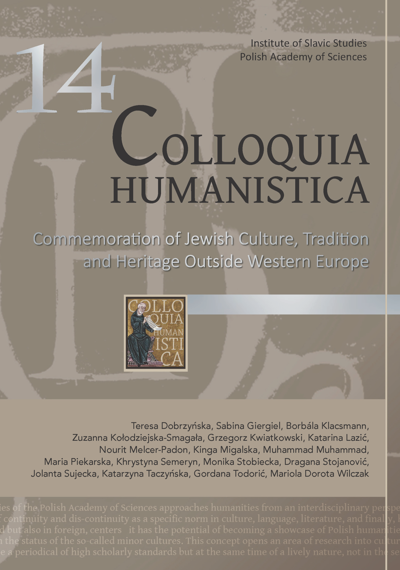
No. 14 (2025): Commemoration of Jewish Culture, Tradition and Heritage Outside Western Europe
					View No. 14 (2025): Commemoration of Jewish Culture, Tradition and Heritage Outside Western Europe

The focus of this year’s issue – already the 14th – of Colloquia Humanistica is the commemoration of Jewish culture, tradition and memory, mainly in Central Europe, in Poland, Ukraine, Hungary, Serbia and Croatia. Essentially, however, both the thematic block and the “Discussion. Presentations. Book Reviews” section in issue 14 of Colloquia Humanistica contain studies, articles and presentations that demand not only remembrance for people, buildings and objects, but (through a critical depiction of the status quo) active efforts to change the official memory paradigm in countries such as Bulgaria, Poland (Jolanta Sujecka, Katarzyna Taczyńska) and Hungary (Borbála Klacsmann). The “Discussions. Book Reviews. Presentations” section complements this subject matter, as it contains an article in which Jolanta Sujecka discusses Jewish sites of memory on the examples of Sofia, Kielce and Warsaw, Muhammad Muhammad’s paper on the perception of Jews in the Qur'an, but also Grzegorz Kwiatkowski’s text on the memory of the Jews from Pomerania, Monika Stobiecka`s presentation of an exhibition at the Polin Museum of Polish Jews dedicated to the memory of (post)Jewish Shtetl Opatów, Nourit Melcer-Padon’s presentation of an Italian monograph by Benedetto Ligorio, and Katarzyna Taczyńska’s review of an anthology of Polish Yiddish women poets translated from Polish into Serbian. An article by Teresa Dobrzyńska outlines the Slavic Comparative Metrics programme, headed by Lucylla Pszczołowska, at the Polish Academy of Sciences’ Institute of Literary Research.

Conception and academic editing of the issue: Katarzyna Taczyńska, Jolanta Sujecka & Monika Stobiecka

List of reviewers for the issue

Original Table of Contents
(articles’ titles in original language, unrelated to the user interface language)

Published: 2025-12-06
View All Issues